How Much Should a DSO Pay for Dental Lab Work? A Practical Guide to Dental Lab Pricing
For a growing Dental Service Organization (DSO) or multi-location dental practices, dental lab pricing can become a significant and recurring operating expense.
That makes pricing an important part of any laboratory partnership decision.
But comparing dental labs based only on a fee schedule can be misleading.
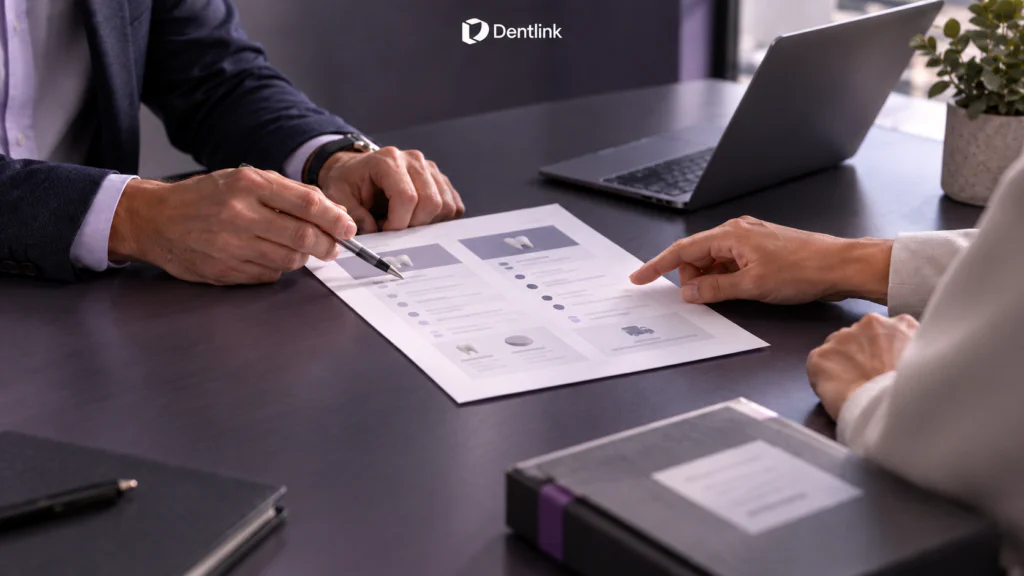
The lowest price per restoration does not always mean the lowest total cost.
Two labs may quote different prices for what appears to be the same restoration because their materials, equipment, production processes, support, and included services may differ.
For a DSO, the better question is not simply:
“How much does this crown cost?”
It is:
“What will this lab actually cost us to operate with?”
Here are the key factors to consider when evaluating dental lab pricing.
Table of Contents
1. Make Sure You Are Comparing the Same Thing
The first mistake in comparing dental lab pricing is assuming that two fee schedules are directly comparable.
A zirconia crown, for example, may involve different materials, manufacturers, production processes, or included services depending on the laboratory.
Before comparing prices, check:
- Restoration material and manufacturer
- Implant components
- Digital design and customization
- Shipping
- Rush fees
- Remake policies
- Other add-on charges
A $100 restoration and a $125 restoration may not actually represent the same service.
DO NOT compare the number before comparing what the number includes.
For DSO procurement teams, a standardized fee comparison can help evaluate equivalent products and services across potential laboratory partners.
2. Understand What Is Behind the Price
Dental lab pricing reflects much more than the final restoration.
Behind every case is a production system:
Materials → Digital Design → Milling/Printing → Finishing → Quality Control → Shipping → Support
Laboratories may make very different investments at each stage.
One lab may optimize primarily for low production cost, while another may invest more in premium materials, advanced equipment, experienced technicians, and quality control.
Ask prospective lab partners:
- What materials and manufacturers do you use?
- What production equipment supports your cases?
- How experienced are your technicians?
- How is quality controlled?
- What is your remake rate?
A lower fee can be attractive, but DSOs should understand whether that lower cost comes from operational efficiency or a fundamentally different production model.
3. Look at Total Cost, Not Just the Lab Fee
The fee on the invoice is only one part of the cost of a laboratory relationship.
Consider two hypothetical labs:
Lab A
- Lower restoration fee
- Higher remake rate
- Less predictable turnaround
- More manual follow-up
Lab B
- Slightly higher fee
- Lower remake rate
- Digital case tracking
- More predictable production
Lab A may look cheaper initially. But a remake can also require additional shipping, staff time, another patient appointment, chair time, and schedule coordination.
The same applies to delayed cases.
A useful framework is:
Total Cost = Lab Fees + Remake Costs + Additional Fees + Administrative Cost + Operational Impact
Not every component needs to be calculated precisely. But considering the full picture can significantly improve a DSO’s dental lab pricing evaluation.
4. Remake Rate Matters
Remakes can have a meaningful financial and operational impact at DSO scale.
If a DSO manages thousands of restorations annually, even a small difference in remake rate can create hundreds of additional cases that need to be produced, shipped, scheduled, and managed.
Ask every prospective laboratory:
“What is your remake rate, and how do you define a remake?”
The definition matters because laboratories may measure remakes differently.
At Dentlink, our remake rate is below 1%, providing DSO and practice partners with a measurable indicator of production consistency.
5. Turnaround Has Financial Value
A laboratory with the lowest price is not necessarily the most cost-effective if cases are frequently delayed.
A missed delivery can lead to:
Delayed restoration → Rescheduled appointment → Staff coordination → Patient communication → Schedule disruption
For an individual practice, this may be manageable. Across dozens or hundreds of locations, it can become a significant operational issue.
When evaluating dental lab pricing, ask:
- What is the standard turnaround?
- How consistently is it achieved?
- Can cases be tracked in real time?
- How are delays communicated?
- How are rush cases handled?
A predictable five-day turnaround can be more valuable than a laboratory that sometimes delivers in three days and sometimes takes eight.
6. Consider the Cost of Managing Multiple Labs
Another cost often missing from a fee schedule is administrative complexity.
If 100 practices use several different laboratories, the DSO may need to manage multiple:
- Fee schedules
- Ordering systems
- Billing processes
- Points of contact
- Remake policies
- Shipping workflows
- Reporting systems
Standardizing laboratory relationships can make it easier to negotiate pricing, monitor spending, standardize workflows, and track performance across locations.
This means a lab with a slightly higher fee may still be more cost-effective if it significantly reduces administrative complexity.
7. Your Volume Should Create Pricing Leverage
One of the biggest advantages a DSO brings to a laboratory relationship is volume.
A DSO representing hundreds or thousands of cases should be able to explore a more strategic dental lab pricing model.
Ask about:
- Network pricing: Can participating locations receive standardized pricing?
- Volume tiers: Does pricing improve as case volume increases?
- Growth-based pricing: Does the pricing structure adjust as the organization grows?
- Acquisition support: Can newly acquired practices join the same program?
- Category pricing: Can high-volume restoration categories receive negotiated rates?
The objective is not simply to force the lowest possible fee.
It is to create a pricing structure that rewards scale while remaining sustainable for the laboratory.
8. Evaluate Price Alongside Infrastructure
Large dental laboratories may have significant infrastructure behind their pricing, including production facilities, digital case management, tracking, analytics, technician teams, and dedicated support.
Smaller laboratories may offer competitive pricing and highly personal service but may not provide the same level of technology or operational infrastructure.
Neither model is automatically better.
The key question is:
“What level of infrastructure does our organization need, and what are we paying for it?”
For a DSO, real-time case visibility, standardized workflows, and scalable support can have meaningful operational value.
The goal is to find the right balance between price, quality, service, and infrastructure.
DSO Dental Lab Pricing: A Simple Scorecard
| Factor | What to Evaluate |
|---|---|
| Base Price | Is the fee competitive for equivalent products? |
| Materials | What materials and manufacturers are used? |
| Remake Rate | How often do cases need to be remade? |
| Turnaround | How consistently is delivery achieved? |
| Additional Fees | Are shipping, rush, or other charges separate? |
| Support | Is there a dedicated contact? |
| Technology | Can cases be tracked digitally? |
| Capacity | Can the lab handle significant volume growth? |
| Volume Pricing | Does scale improve your pricing? |
| Administration | How much internal work does the relationship require? |
How Dentlink Approaches Dental Lab Pricing
At Dentlink, we believe DSO dental lab pricing should not require a trade-off between cost efficiency and operational quality.
Our approach combines competitive, volume-based pricing with the infrastructure needed to support organizations operating at scale.
That includes:
- High-quality materials and established production equipment
- Experienced technicians
- Dedicated support
- Digital case tracking
- Dashboard-based analytics
- Scalable production capacity
- Network-based pricing for DSO partners
More than 3,000 dental professionals have used Dentlink, and we currently work with 11 DSO networks across the US and Australia. Our remake rate is below 1%.
We aim to provide the infrastructure of a large laboratory without automatically requiring large-lab pricing.
A complimentary first case also gives your team an opportunity to evaluate the restoration, communication, turnaround, and overall workflow before making a larger commitment.
The Bottom Line
The lowest dental lab fee does not always mean the lowest total cost.
When evaluating dental lab pricing, DSOs should consider:
Competitive pricing + consistent quality + predictable turnaround + low remake rates + efficient technology + reliable support + scalable infrastructure
So don’t ask only:
“What’s your price?”
Ask:
“What will it cost us to work with you—and what are we getting for that cost?”
That is the question that can turn a laboratory vendor into a true DSO partner.
Frequently Asked Questions
How should a DSO compare dental lab pricing?
Compare equivalent products and services while considering remake rates, turnaround, additional fees, support, technology, and administrative costs, not just the base fee.
Does higher dental lab pricing mean better quality?
Not necessarily. DSOs should evaluate the materials, equipment, technicians, quality control, service, and infrastructure behind the price.
Do dental labs offer volume pricing for DSOs?
Many laboratories offer volume or network pricing for DSOs and multi-location organizations. Ask about volume tiers, standardized pricing, and how rates change as case volume grows.
Your first crown is on us.
Free implant crown, free scanbody kit, and $200 off your next case. Just send your first scan.
Create your Dentlink account, register your clinic, then order from the scanner you already use.