When the Implant Plan Changes: Why Lab Communication Matters
Implant restoration does not always begin with a case that went exactly according to the original plan.
Bone conditions, implant stability, healing, and patient needs can all influence the clinical decisions made along the way. And when the treatment path changes, there is another important question to consider:
Does your dental lab understand what changed—and what you need from the final restoration?
Two recent cases from Dr. Henry Hur show why that communication matters.
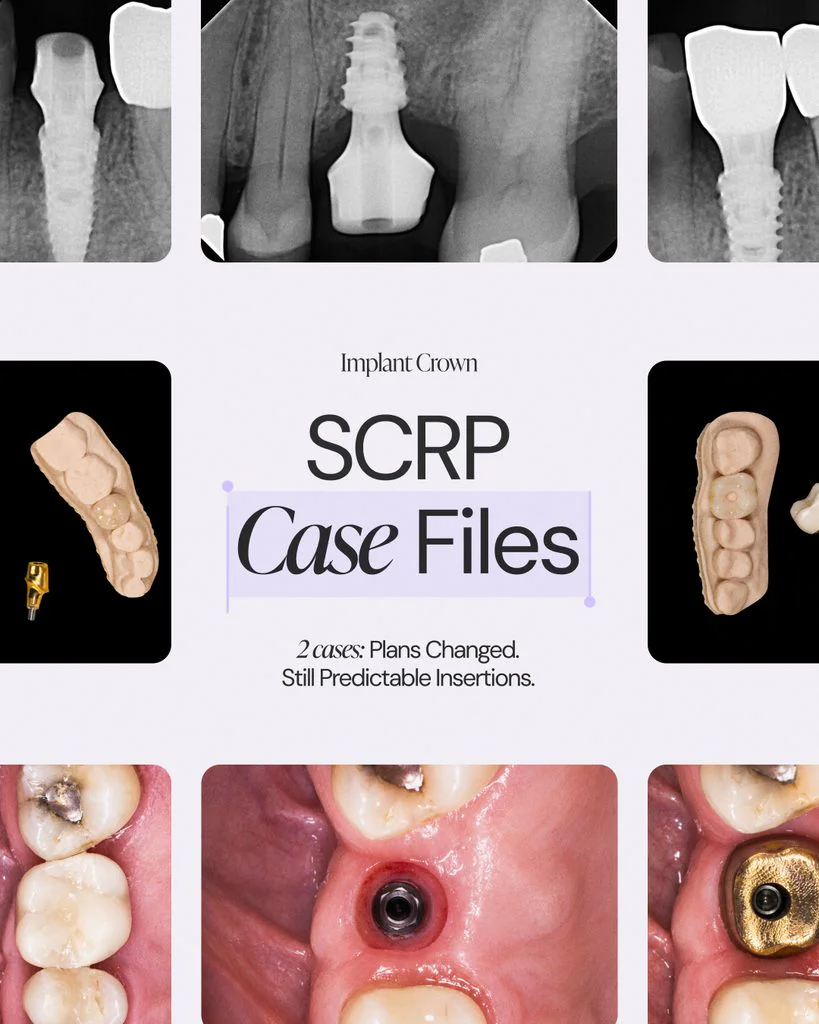
Two Implant Cases. Two Different Clinical Paths.
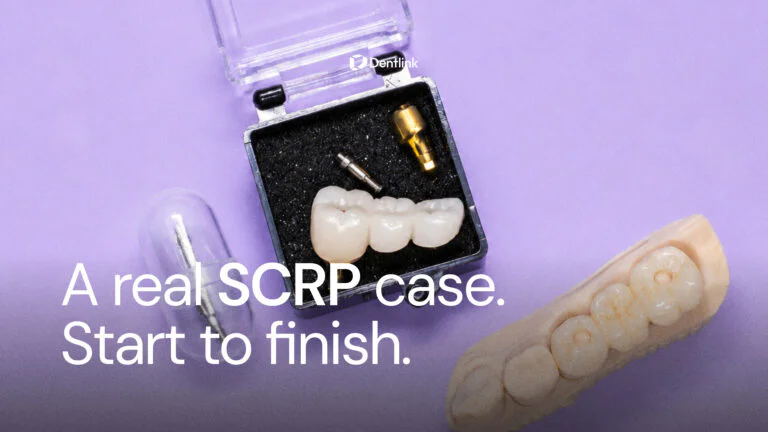
Both cases ultimately received SCRP crowns fabricated by Dentlink.
But the paths to get there were very different.
Case 1: When Implant Placement Had to Wait
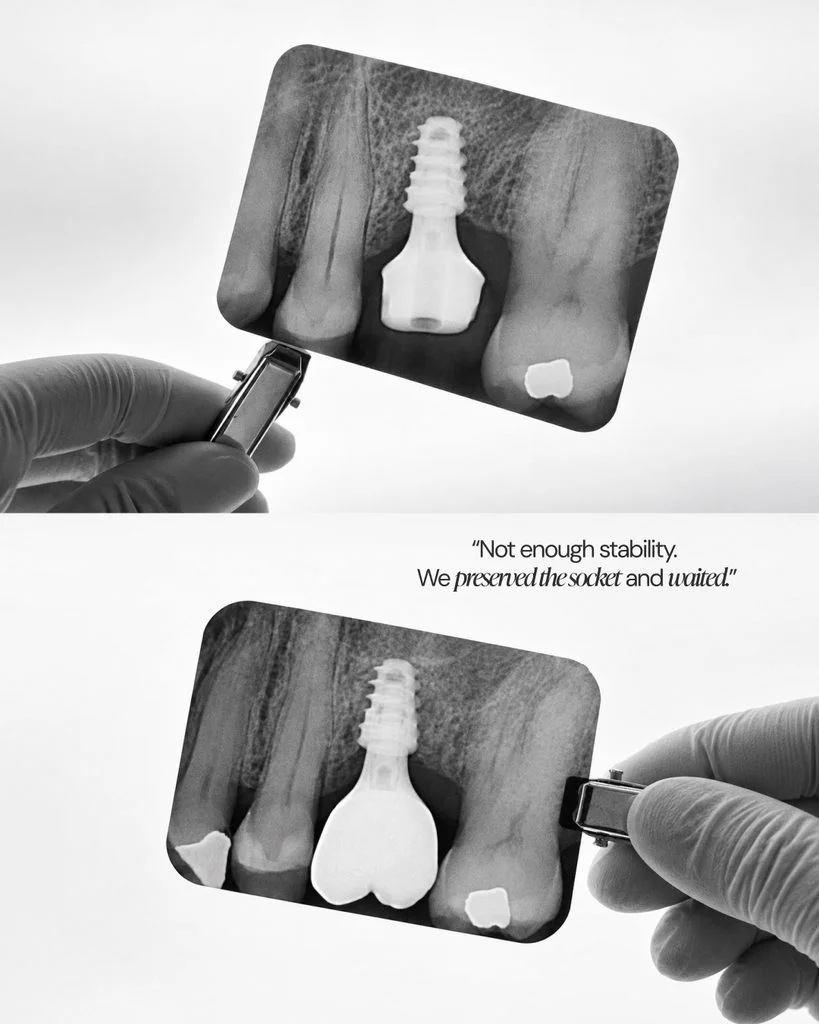
For a lower left first molar, immediate implant placement was initially considered.
However, the defect around the septal bone made it difficult to achieve sufficient implant stability.
Instead of proceeding with immediate placement, Dr. Hur changed the treatment path.
The socket was preserved with a corticocancellous allograft and collagen membrane, followed by four months of healing.
An implant was then placed using a minimal papilla-sparing flap. After another three months of uneventful osseointegration, the final scan was taken.
The case was ready for its final implant restoration.
The SCRP crown was fabricated by Dentlink and inserted with minimal adjustment.
As Dr. Hur described in his original case:
The treatment took additional time, but the final outcome was achieved without complications.
Case 2: When Immediate Implant Placement Was Possible
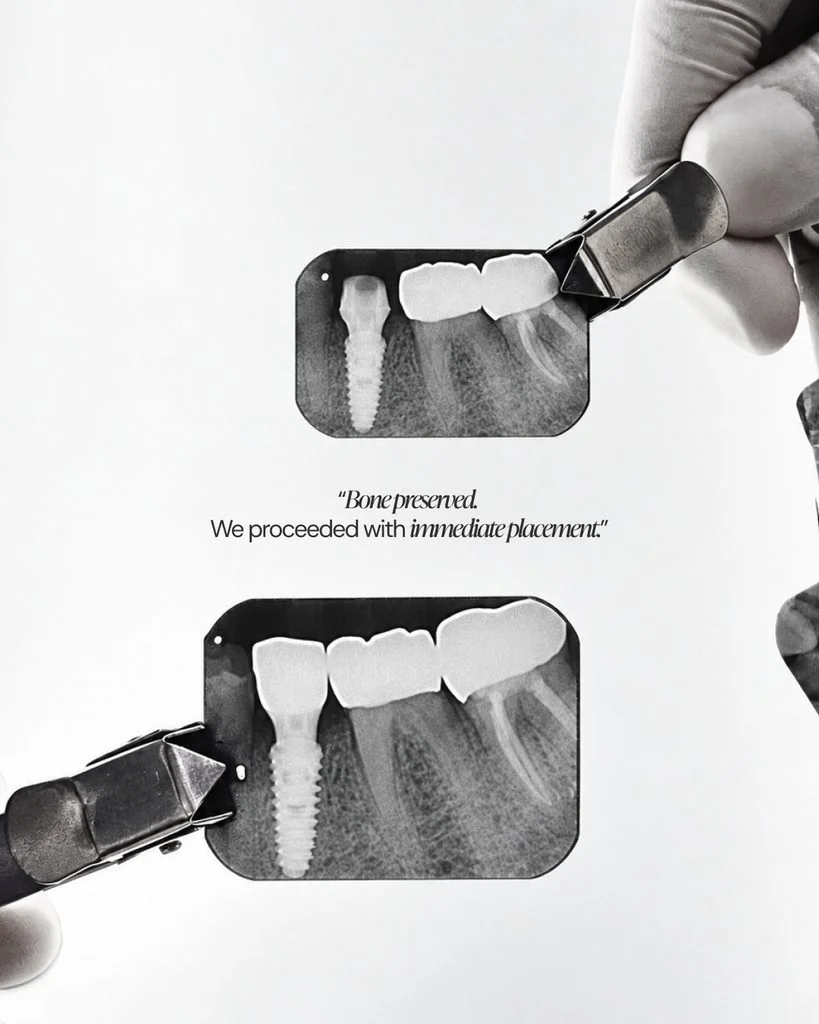
The second case followed a very different path.
The patient presented with a hopeless lower left second premolar requiring extraction. While a broader full-arch rehabilitation was discussed because of severe occlusal wear, the patient preferred to address the immediate problem area first.
The tooth was carefully extracted with an emphasis on preserving the surrounding bone.
This time, Dr. Hur proceeded with his immediate implant placement protocol.
Once again, the final restoration was an SCRP crown fabricated by Dentlink.
The crown and abutment were cemented, the prosthesis was removed to clean excess cement, and it was then ready for final seating.
Two cases.
One required preservation and time.
The other allowed immediate placement.
Yet both eventually arrived at the same critical stage: turning the clinical situation into a predictable final restoration.
Want to understand why an SCRP restoration may be selected for an implant case? Learn how SCRP compares with other implant restoration options.
When the Clinical Plan Changes, the Lab Needs to Know
This is where the relationship between dentist and technician becomes important.
A dental technician does not experience what happens chairside firsthand.
The technician works from the clinical information, records, scans, images, instructions, and communication received from the dentist.
So when the clinical path changes, keeping the lab informed helps the restoration reflect what actually happened—not simply what was originally planned.
But communication is not only about a single case.
Over time, a technician can also learn how a particular dentist likes cases to be designed and delivered.
For Dr. Hur, that familiarity has become part of his workflow with his designated Dentlink technician, Mr. Kim.
“Mr. Kim knows my preferences, so I always get predictable insertions, including the above 2 cases.”
— Dr. Henry Hur (@henrydentistry)
That short comment gets to the heart of these two cases.
The clinical paths were different.
The restorative expectation remained clear.
See another real SCRP implant case and the restorative advantages behind the design.
Dentist–Technician Communication Builds Over Time
Every implant restoration case carries its own clinical variables.
That is why a strong dentist–technician relationship can offer something beyond simply transmitting an order to a dental lab.
A technician who becomes familiar with a dentist’s preferences can better understand what that dentist expects from:
- fit and seating,
- occlusion,
- contour and design,
- restorative approach,
- and ultimately, the delivery appointment.
At Dentlink, every dentist works with a 1:1 designated technician who can become familiar with those preferences from case to case.
That continuity matters particularly when a case does not follow a textbook path.
The dentist makes the clinical decisions chairside. The technician needs to understand those decisions well enough to translate them into the final restoration. See how 1:1 dental lab communication can make a difference from one case to the next.
Different Paths. Predictable Insertions.
One of these cases required socket preservation and delayed implant placement.
The other proceeded with immediate implant placement.
Both ultimately received Dentlink SCRP restorations with minimal adjustment, and Dr. Hur described the insertions as predictable.
That is the takeaway from these cases:
Clinical decisions can change along the way.
When the dentist and technician stay connected, the restoration can adapt with them.
A predictable implant restoration is not only about what happens at the lab bench. It is also about understanding the clinical reality behind the case.
Made by Masters.
Have an implant case you would like to discuss?
Send your next case to Dentlink or talk with us about your restorative needs.
Your first crown is on us.
Free implant crown, free scanbody kit, and $200 off your next case. Just send your first scan.
Create your Dentlink account, register your clinic, then order from the scanner you already use.