Digital Implant Planning: What to Check Before Your Surgical Guide Is Made
Digital implant planning involves more than selecting an implant position. Before a surgical guide is fabricated, the CBCT and intraoral scan must be aligned, the proposed implant position reviewed, and the drilling protocol confirmed.
But what happens when the two datasets don’t quite line up?
In a real Dentlink linkGuide case, a Case Master identified an alignment discrepancy, shared a diagnostic report, and asked the dentist to review the findings. The dentist also raised a specific question about drilling depth.
This case highlights five details worth checking before approving your surgical guide—and why direct communication with your dental lab matters.
Why Data Alignment Matters in Digital Implant Planning
Digital implant planning combines anatomical and restorative information to help determine the intended implant position.
CBCT provides three-dimensional information about bone anatomy and surrounding structures. Intraoral scans capture the surface geometry of the teeth and soft tissues.
These datasets need to be registered into a common coordinate system to create a digital model for implant planning.
But even when both datasets are available, they may not align exactly.
Differences can arise from factors such as CBCT artifacts, scan quality, registration methods, or the anatomical reference points used during alignment.
An alignment discrepancy doesn’t automatically mean a rescan is necessary. But it does mean the data should be reviewed before the surgical guide design is approved.
Research on CBCT and intraoral scan registration has shown that registration accuracy depends on multiple technical and clinical factors. A clinical study published in Clinical Oral Implants Research examined how different registration approaches and clinical conditions can affect the superimposition process.
For dentists, the practical takeaway is straightforward: don’t evaluate the implant position without considering the reliability of the data behind it.
A Real Implant Planning Case: See That Slight Shift?
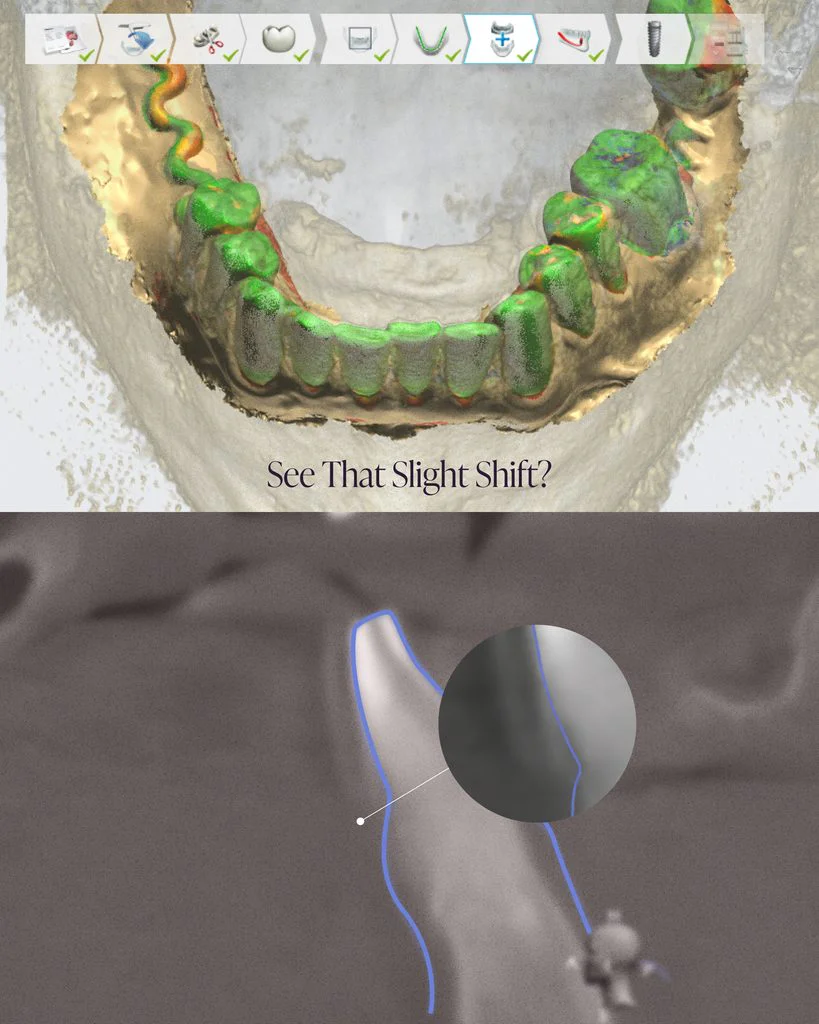
During the alignment stage of a linkGuide case, a Dentlink Case Master noticed a discrepancy between the CBCT and intraoral scan data.
The CBCT appeared to have shifted slightly relative to the scan in certain areas.
Rather than proceeding without clarification, the Case Master documented the finding and shared it with the dentist through linkTalk.
What the Case Master Flagged
The message explained:
“During the alignment stage for this case, we found some discrepancies between the CT and scan data in certain areas, and it appears that the CT moved slightly.”
The Case Master also noted that the discrepancy could affect the accuracy of the guide.
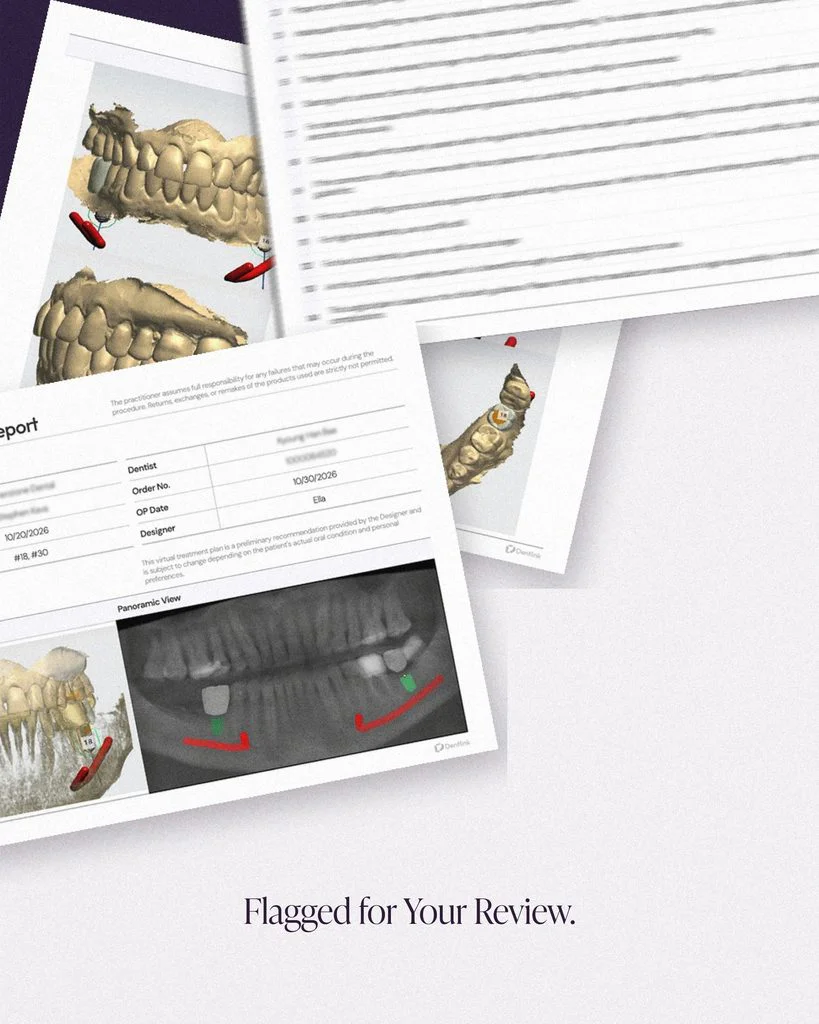
A diagnostic report and supporting images were provided, followed by a request for the dentist to review and confirm.
The important part wasn’t simply finding a mismatch. It was making sure the dentist had an opportunity to review it before the case moved forward.
From a Data Discrepancy to a Clinical Review
A diagnostic report gives the dentist a clearer view of what needs attention.
Instead of receiving a general message that the scan data may be problematic, the dentist can see the relevant area and evaluate it in the context of the planned procedure.
In this case, the Case Master used linkTalk to share the findings and request confirmation.
The lab identified a technical concern. The dentist was asked to review its clinical significance.
This is an important distinction in digital implant planning: the lab supports the planning process, while the dentist reviews and approves the clinical plan.
5 Things to Check Before Approving Your Surgical Guide
Whether you’re working with a new dental lab or reviewing a complex implant case, these five checks can help make the surgical guide planning process more predictable.
1. Check CBCT and Intraoral Scan Alignment
Start by reviewing how the CBCT and intraoral scan data overlap.
Look at the areas used for registration and the regions relevant to the planned implant site.
Ask:
- Do the datasets align appropriately?
- Is the discrepancy localized or more widespread?
- Could the difference affect the proposed implant position or guide support?
The goal is not to assume that every visible difference indicates an error. It’s to determine whether the registration is reliable enough for the intended plan.
2. Review the Implant Position Against the Restoration
Digital implant planning should consider the final restoration, not just the available bone.
The proposed implant position needs to be evaluated in relation to the intended tooth position, surrounding anatomy, and prosthetic requirements.
This is the principle behind restorative-driven implant planning.
With Dentlink’s linkGuide, the workflow starts with the proposed crown position. The implant is then planned beneath that restoration.
The dentist reviews and approves the proposed plan before the guide is fabricated.
3. Confirm the Surgical Kit and Sleeve Specifications
A surgical guide needs to work with the surgical system selected for the case.
Before approving the design, confirm the planned implant system and the guide components required for the procedure.
Depending on the system, relevant details may include:
- Implant system and dimensions
- Surgical kit compatibility
- Sleeve type and position
- Drill sequence and required offsets
- Applicable drilling protocol
These specifications should be checked against the manufacturer’s instructions for the selected surgical system.
With linkGuide, the surgical report provides site-specific information about the planned implant, sleeve, and drilling sequence.
4. Verify the Planned Drilling Depth
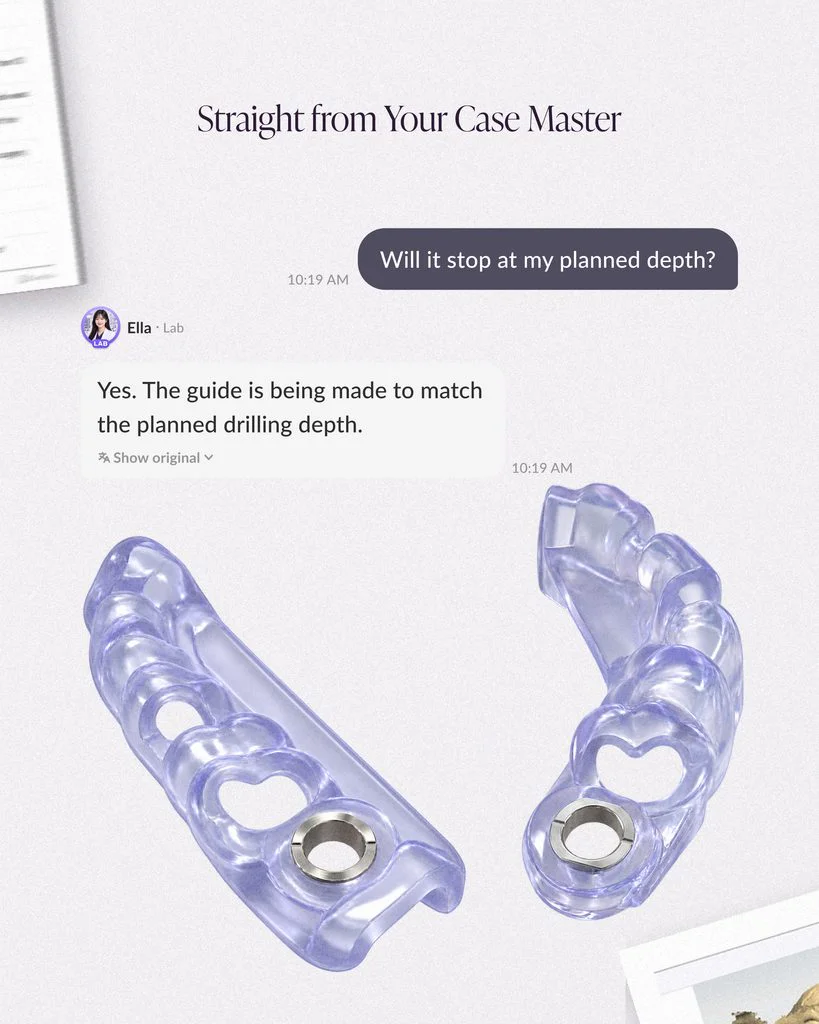
This was another important question raised in the actual linkGuide conversation.
The dentist wanted to confirm that the guide accounted for the drilling protocol of a Hiossen surgical kit.
The concern was specific: avoiding overdrilling beyond the planned implant depth.
The Case Master responded that the guide was being fabricated for drilling according to the planned depth, with the intention of preventing overdrilling.
This exchange illustrates a detail that deserves attention during surgical guide planning.
The planned implant depth and the drilling protocol need to be considered together.
The guide design alone does not guarantee depth control. Drill geometry, sleeve specifications, stops or other depth-control mechanisms, guide seating, and the manufacturer’s protocol can all affect how the planned depth is achieved.
For the dentist, it’s worth confirming these details before fabrication rather than leaving the question until surgery.
5. Review the Diagnostic Report and Confirm the Plan
Before the surgical guide is produced, review the available planning information and any concerns raised by the lab.
Check whether the proposed design reflects the intended implant position, restoration, surgical system, and clinical requirements.
If something is unclear, ask.
In the real Dentlink case, the Case Master flagged an alignment discrepancy and requested confirmation. The dentist also used the conversation to clarify the planned drilling depth.
Both exchanges demonstrate the value of having a direct communication channel during the planning process.
The final design should proceed only after the dentist has reviewed and approved the plan.
How linkGuide Supports Digital Implant Planning
A well-designed surgical guide begins with a planning process that brings together anatomical data, restorative goals, and clinical requirements.
Dentlink’s linkGuide supports this workflow through restorative-first planning, Case Master review, and direct communication.
Restorative-First Implant Planning
The planned tooth position provides the starting point for the implant design.
From there, the Case Master prepares the implant plan using the submitted scan and CBCT data.
The dentist reviews the proposed plan before fabrication.
Direct Communication With Your Case Master
With linkTalk, dentists can communicate directly with the Case Master working on their case.
Questions about alignment, the proposed design, or surgical kit requirements can be discussed during planning.
As this real case demonstrates, that communication can work both ways.
The Case Master can flag a concern for the dentist’s review, and the dentist can ask specific questions about the planned procedure.
Surgical Report and Guide Production
Every linkGuide includes a surgical report with planning information for the selected implant sites.
Dentists can choose between a planning-and-printing service or a planning-only option when they prefer to print the guide in-house.
Both options are based on a plan reviewed and approved by the dentist.
Learn more about linkGuide surgical guide planning and fabrication.
Ready to Plan Your Next Implant Case?
Before your next surgical guide is made, make sure the details are clear—from CBCT and scan alignment to implant position and drilling depth.
With Dentlink, you can send your case, review the proposed plan, and communicate directly with your Case Master before fabrication.
Order your first linkGuide through the Dentlink Portal.
Your first eligible case is on us for new clinics. No card, no contract.
Made by Masters.
Frequently asked questions
What if the CBCT and intraoral scan don't align?
Can a surgical guide prevent overdrilling?
Who approves the final surgical guide plan?
Your first crown is on us.
Free implant crown, free scanbody kit, and $200 off your next case. Just send your first scan.

Create your Dentlink account, register your clinic, add Dentlink as your lab in your scanner software, then send your case.