SCRP vs SRP vs CRP: Which Implant Crown Is Right?
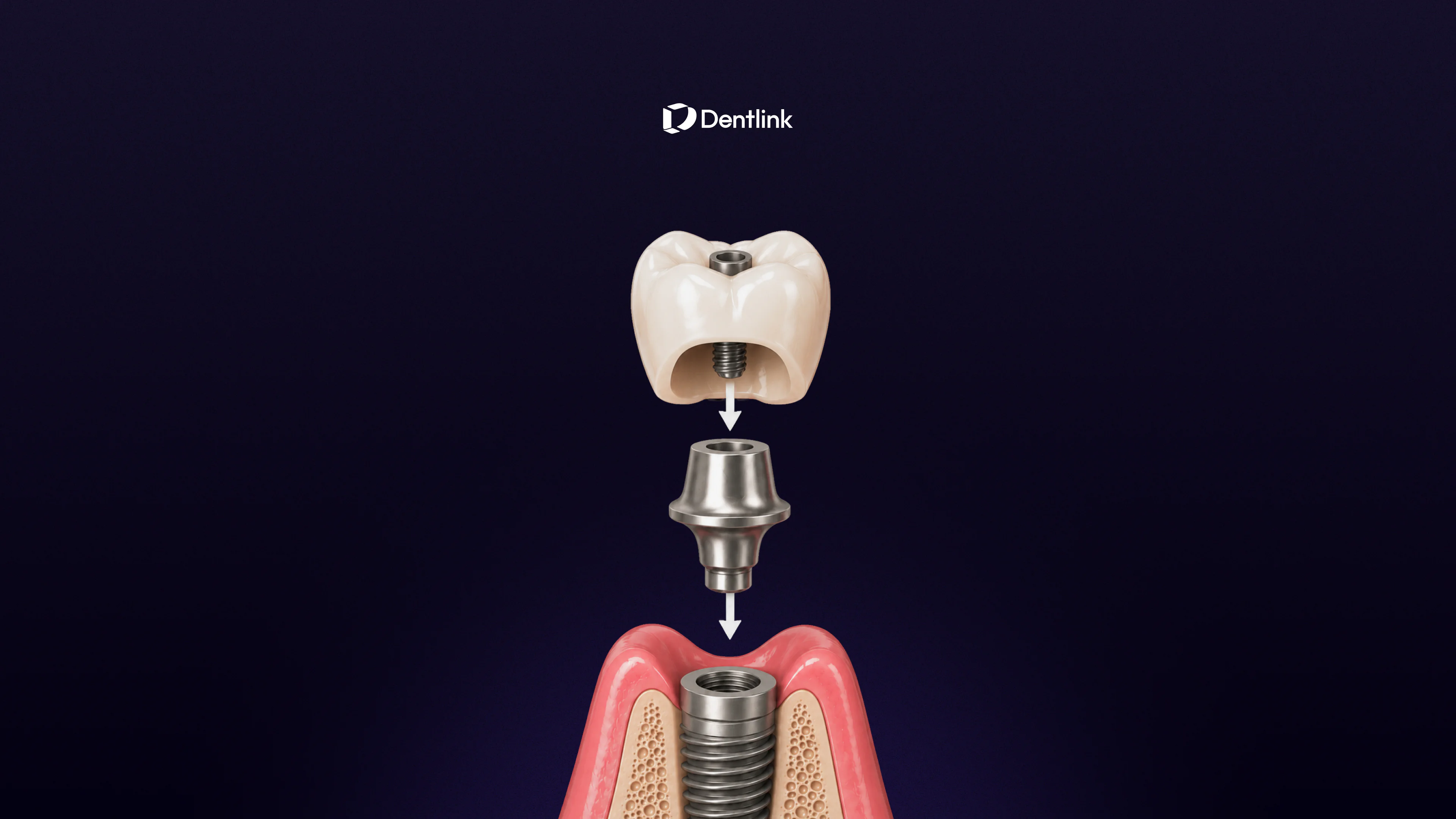
SCRP vs SRP vs CRP: these are three common implant restoration options, but each offers different advantages depending on the clinical situation.
Understanding the differences can help dentists choose the most appropriate restoration for esthetics, maintenance, and long-term success.
SRP vs CRP: Understanding the Two Traditional Approaches
What Is SRP?
SRP (Screw-Retained Prosthesis) is attached directly to the implant using a screw.
Advantages
- Fully retrievable for future maintenance
- No residual cement risk
- Simplified repair or replacement
Limitations
- Screw access hole remains visible on the occlusal surface
- Esthetics may be compromised in certain cases
SRP is often preferred when long-term maintenance and retrievability are priorities.
What Is CRP?
CRP (Cement-Retained Prosthesis) is cemented onto the abutment rather than secured directly with a screw.
Advantages
- Excellent esthetics
- No visible screw access hole
- Passive fit is easier to achieve
Limitations
- Residual cement may contribute to peri-implant complications
- Retrieval can be difficult if maintenance is required
For anterior restorations where appearance is critical, CRP remains a popular option.
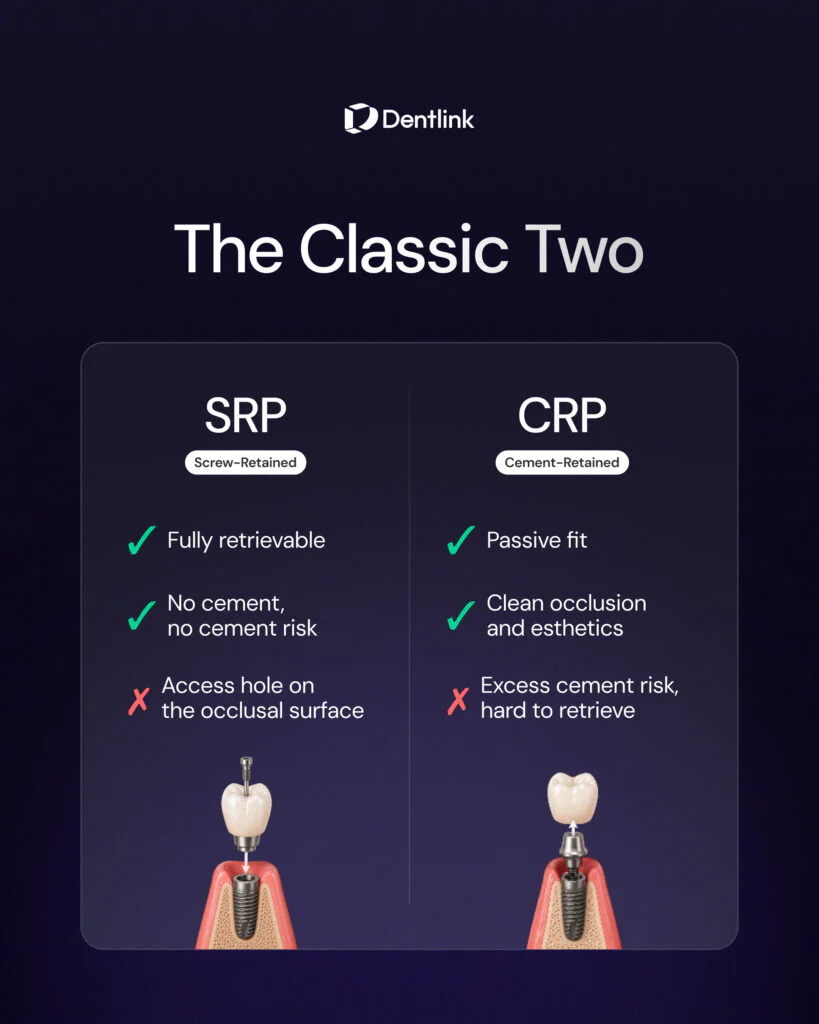
As shown above, neither approach is perfect. SRP excels in retrievability, while CRP offers superior esthetics and passive fit. These trade-offs led to the development of another option: SCRP.
SCRP: Combining the Best of Both
SCRP (Screw- and Cement-Retained Prosthesis) combines the advantages of both restoration methods.
The crown is cemented to the abutment outside the patient’s mouth before being screw-retained onto the implant. This workflow helps reduce excess cement while maintaining retrievability.
Benefits include:
- Excellent retrievability
- Better cement control
- Reliable passive fit
- Reduced biological complications compared with traditional cement-retained restorations
Because of these advantages, SCRP has become increasingly popular in modern implant prosthodontics.
While selecting the right restoration type is important, long-term success also depends on how well the restoration is designed and fabricated. Experienced dental technicians play a critical role in achieving accurate fit, function, and esthetics. Learn more in From the Lab: Dental Technician Experience: Why It Matters for Crown Quality.
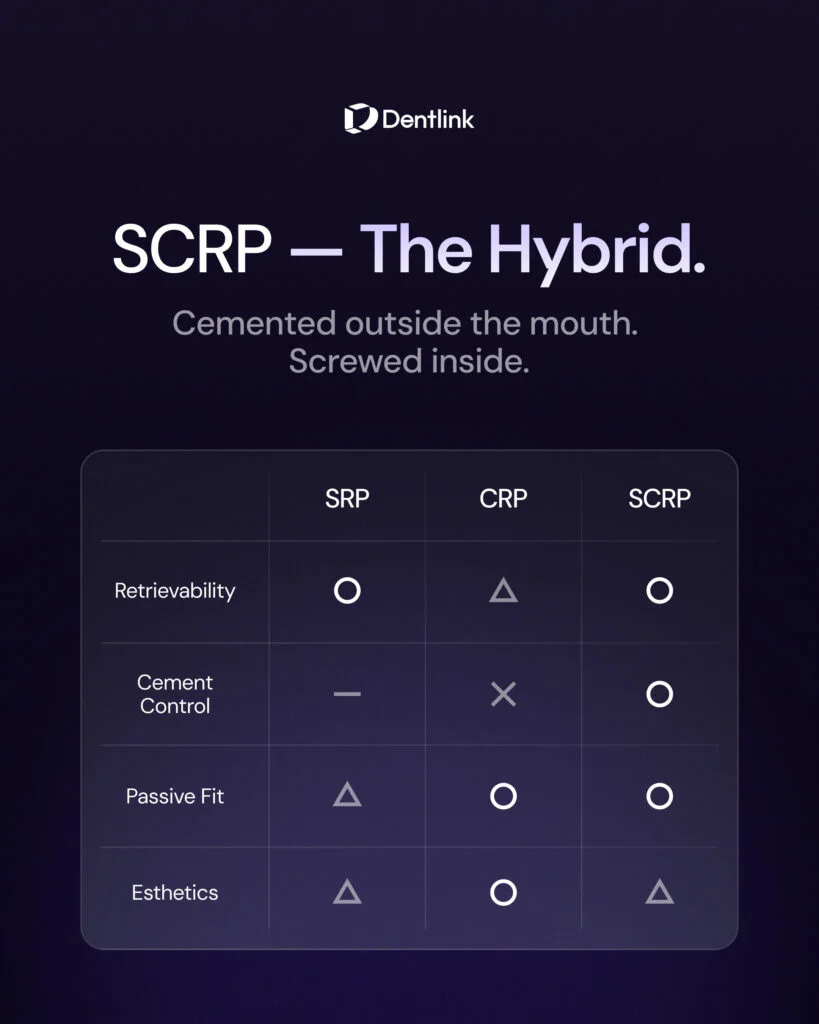
SCRP vs SRP vs CRP Comparison
| Feature | SRP | CRP | SCRP |
|---|---|---|---|
| Retrievability | ✓ | Limited | ✓ |
| Cement Control | ✓ | ✗ | ✓ |
| Passive Fit | Moderate | Excellent | Excellent |
| Esthetics | Moderate | Excellent | Good |
Each method has strengths depending on the clinical indication.
Rather than asking which restoration is “best,” clinicians should consider which approach best supports long-term treatment success for each patient.
Choosing the appropriate restoration method is only one part of achieving a successful implant outcome. Clinical execution and laboratory precision are equally important. See how careful planning and fabrication contributed to an excellent tissue outcome in our case study: Perfect Tissue Fit in Implant Restorations: Why Clinical Precision Matters.
How Dentlink Supports Every Restoration Type
At Dentlink, our experienced Korean dental technicians work closely with dentists to fabricate implant restorations tailored to each clinical case.
Whether you prescribe SRP, CRP, or SCRP, every restoration is produced with careful attention to fit, communication, and consistency.
Our goal isn’t to recommend one restoration over another—it’s to help you achieve predictable outcomes with the option that best fits your treatment plan.
Which Restoration Is Right for Your Next Implant Case?
SCRP vs SRP vs CRP isn’t a competition with one universal winner.
Each restoration method offers unique advantages, and selecting the right option depends on the patient’s anatomy, esthetic requirements, maintenance expectations, and overall treatment objectives.
Understanding these differences allows dentists to make more informed restorative decisions and deliver predictable implant outcomes.
Have an upcoming implant case?
We’d be happy to discuss the best restoration option with you. 👉🏻Join us now
Your first crown is on us.
Free implant crown, free scanbody kit, and $200 off your next case. Just send your first scan.
Create your Dentlink account, register your clinic, then order from the scanner you already use.