What Makes a Quality Dental Lab? Look at the Finishing Details
When choosing a quality dental lab, fit and turnaround time are often top priorities. But the final finishing details deserve just as much attention.
A crown may fit well, but does its shade blend with adjacent teeth? Does the surface reflect light naturally? Does the final finish look right in the patient’s smile?
These details matter, especially for restorations where esthetics are just as important as function.
Let’s take a closer look at what skilled dental technicians do behind the scenes—and why the final finishing process deserves your attention.
What Should Dentists Look for in a Quality Dental Lab?
A quality dental lab needs to deliver more than a restoration that fits the preparation.
For dentists, there are several things worth looking at:
- Accurate fit: Margins, contacts, and occlusion that match the clinical requirements.
- Natural-looking appearance: Shade, surface texture, and gloss that complement the patient’s dentition.
- Consistent craftsmanship: Careful attention to detail throughout the fabrication process.
- Clear communication: A lab team that understands the prescription and responds to case-specific requests.
Each plays a role in the final restoration.
And while fit can often be evaluated at the chair, the esthetic finish begins long before the case arrives at your practice.
The Finishing Details Behind Natural-Looking Dental Restorations
Digital design and milling help establish the shape and structure of a restoration.
But the final appearance requires a different kind of attention.
For ceramic crowns and applicable All-on-X restorations, technicians carefully refine the visual details that contribute to a natural-looking result.
1. Shade and Characterization
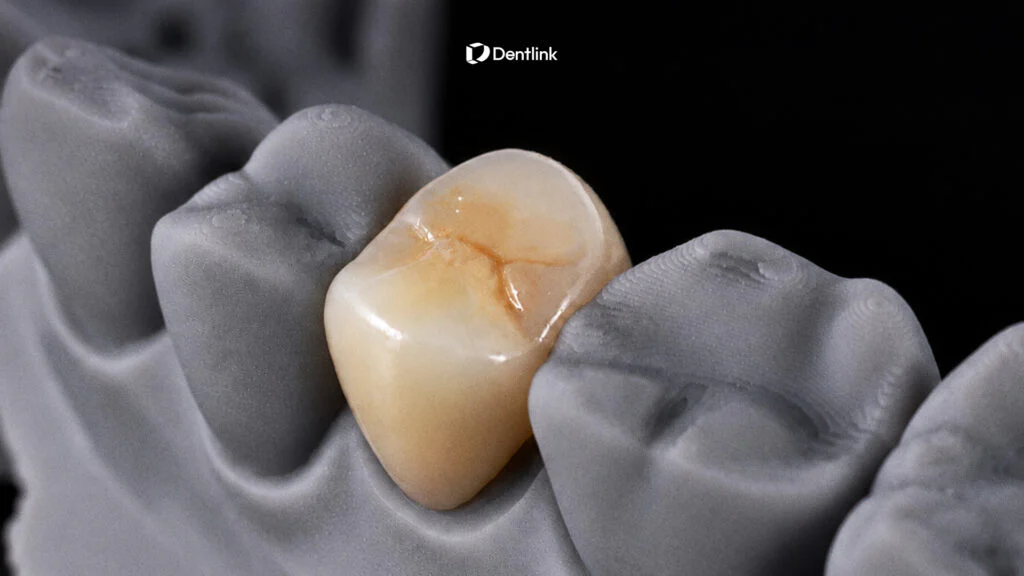
Natural teeth rarely have one uniform shade from the cervical area to the incisal edge.
Subtle variations in color and characterization can help a restoration appear more natural alongside the surrounding dentition.
Through careful staining and characterization, dental technicians work to recreate these variations based on the clinical information provided.
2. Surface Texture and Light Reflection
A restoration’s appearance isn’t determined by shade alone.
Surface texture influences the way light reflects from the restoration. Even with an appropriate shade selection, a surface that reflects light differently from adjacent teeth may look less natural.
This is why careful finishing matters, particularly for restorations in the esthetic zone.
3. Gloss and the Final Finish
The goal isn’t simply to make a restoration as shiny as possible.
It’s to create an appropriate finish that complements the appearance of natural enamel.
Depending on the restorative material and fabrication process, glazing and polishing are used to refine the final surface.
These finishing decisions are part of what distinguishes a carefully fabricated restoration from one that only looks complete.
Watch the Art of Glazing: Craftsmanship Up Close
What does this attention to detail look like at the dental lab?
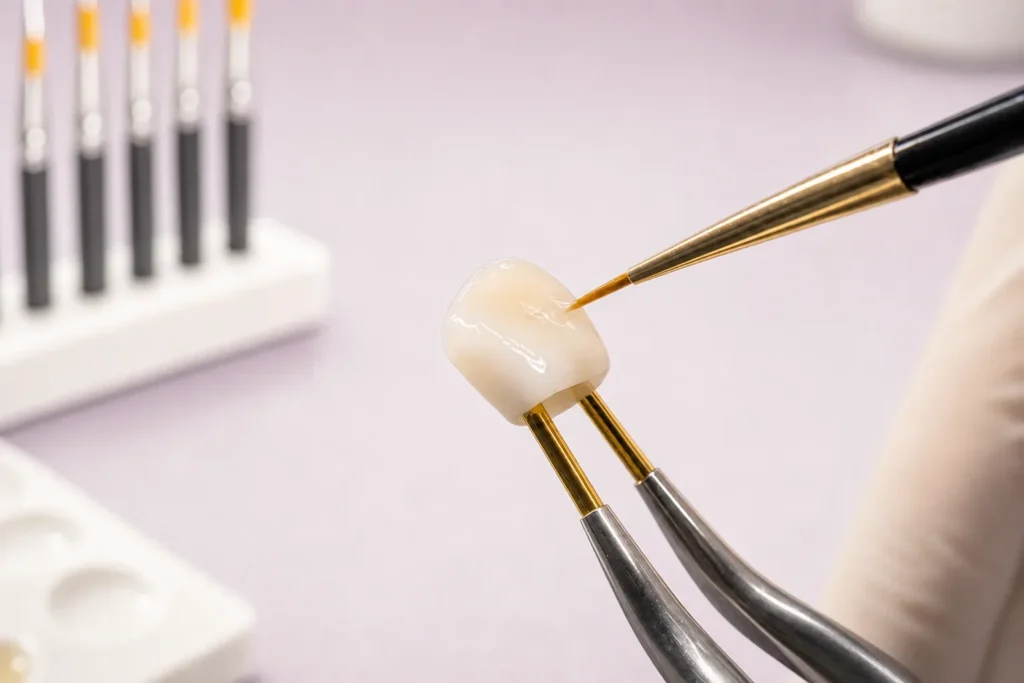
In this 30-second video, you’ll see Dentlink’s skilled dental technicians working on crowns and All-on-X restorations, applying finishing materials with careful, controlled brushstrokes.
Each movement contributes to the shade characterization and final surface appearance.
It’s a close-up look at one of the most detailed stages of dental restoration fabrication.
And it’s a reminder that even with today’s digital workflows, skilled hands remain an important part of the process.
Want to See More from Our Lab?
Take a closer look at the craftsmanship behind every restoration—from detailed finishing work to the final result.
Follow Dentlink on Instagram for more behind-the-scenes moments from our dental lab.
Why Skilled Dental Technicians Matter
Digital technology makes restorative workflows more efficient and provides a precise foundation for fabrication.
But technology alone doesn’t make every clinical or esthetic decision.
An experienced dental technician interprets the case requirements, evaluates the restoration, and refines the details that need individual attention.
At Dentlink, each case is assigned a designated dental technician who works on the restoration throughout the fabrication process.
From digital design to the final finish, the technician’s expertise helps connect the clinical prescription with the completed restoration.
For dentists, that means working with a dental lab partner that considers both the technical requirements and the details of the final appearance.
Choosing a Dental Lab? Look Beyond the Basics.
When evaluating dental lab quality, turnaround time, pricing, and fit are essential considerations.
But it’s also worth looking at how restorations are finished.
How does the lab handle shade characterization? Who checks the final surface details? Can you communicate specific esthetic preferences to the technician working on your case?
These are practical questions that can tell you more about the care behind each restoration.
At Dentlink, we combine digital workflows with the craftsmanship of skilled dental technicians to create restorations that meet the clinical and esthetic requirements of each case.
The details matter. From the first scan to the final brushstroke.
Ready to Send Your Next Case?
Whether you’re ordering a single crown or planning an All-on-X restoration, Dentlink is ready to work with you.
Explore our dental lab services or visit Dentlink to send your next case.
Made by Masters.
Your first crown is on us.
Free implant crown, free scanbody kit, and $200 off your next case. Just send your first scan.

Create your Dentlink account, register your clinic, add Dentlink as your lab in your scanner software, then send your case.