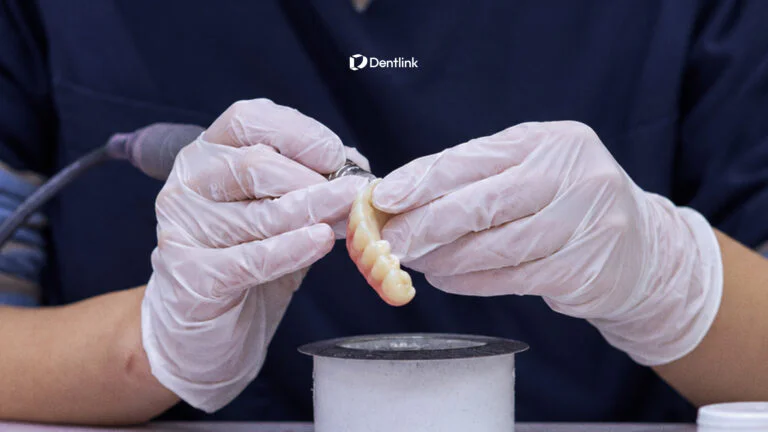
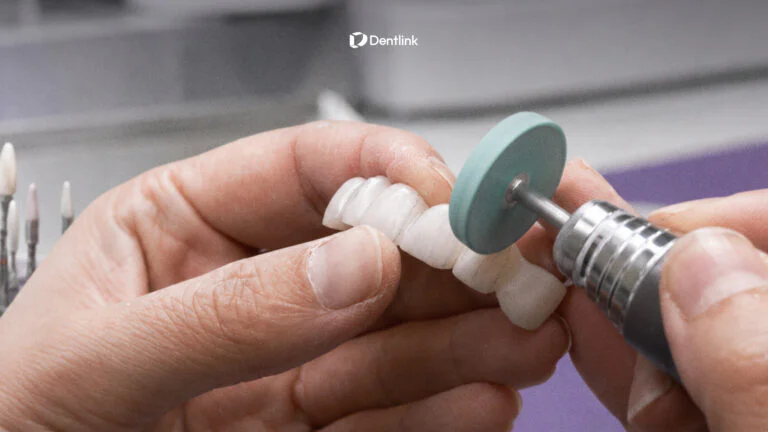
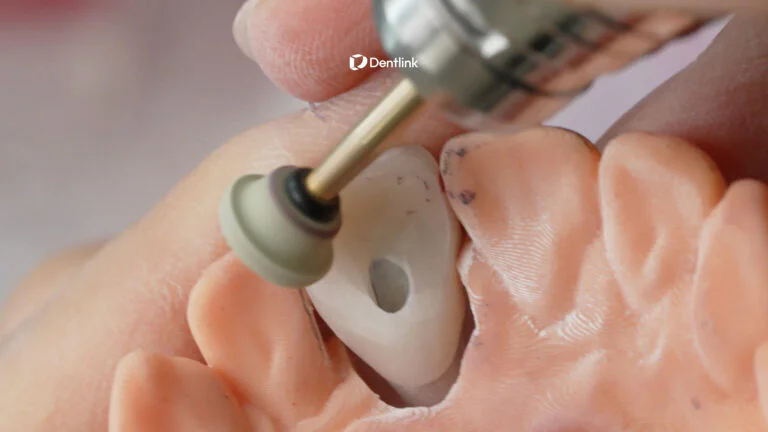
What Makes Porcelain Veneers Look Natural? Inside the Lab
What makes porcelain veneers look like they truly belong in a patient’s smile?
It is not simply choosing the right shade.
Natural-looking porcelain veneers depend on how translucency, value, contour, surface texture, and subtle internal character work together—and how those details relate to the natural teeth around them.
With feldspathic porcelain, many of those decisions are made layer by layer in the hands of the dental technician.
Within a restoration that may be only fractions of a millimeter thick, there is very little room for guesswork.
Every layer is placed with the final smile in mind.
What Makes Porcelain Veneers Look Natural?
Natural teeth are not one uniform shade, opacity, or texture.
The cervical area, body, and incisal edge interact with light differently. Surface texture changes the way light reflects. Small variations in value and translucency create depth rather than a flat, monochromatic appearance.
That is why natural-looking porcelain veneers require more than a good shade match.
The technician has to consider several characteristics together:
- Translucency and opacity
- Value and shade
- Tooth morphology
- Incisal character
- Contour and proportions
- Surface texture
- Light reflection
- The relationship with adjacent natural teeth
The challenge is not making every one of these details visible.
It is knowing how much of each detail the case actually needs.
For a broader look at these elements across restorative dentistry, read What Makes a Dental Restoration Look Natural?
Why Natural-Looking Veneers Are Difficult to Reproduce
A veneer is viewed as part of a smile, not as an isolated ceramic restoration.
That changes the standard for success.
A veneer may look excellent on a model but still appear too bright, too opaque, too uniform, or too highly characterized when placed next to natural teeth.
Especially in anterior cosmetic cases, small differences can become noticeable.
This is why the technician needs to understand the clinical context—not simply the target shade.
What do the adjacent teeth look like?
How does light move through them?
How pronounced is their surface texture?
Should the new veneer blend quietly into the existing dentition, or is it part of a larger smile transformation?
Natural esthetics comes from answering those questions before simply trying to make the restoration “beautiful.”
Where Feldspathic Porcelain Layering Comes In
For highly esthetic cases, feldspathic porcelain gives an experienced ceramist significant control over the visual character of a veneer.
Feldspathic veneers are created by incrementally building and firing porcelain rather than producing the entire restoration from a single uniform ceramic block.
This allows the technician to work within different areas of the restoration and gradually develop the desired optical result.
Layering can help control:
Translucency — how much light passes through different areas of the veneer.
Value — how light or dark the restoration appears relative to adjacent teeth.
Internal character — subtle visual differences that keep the restoration from appearing flat or artificial.
Contour — how the restoration transitions into the surrounding dentition.
But the technique itself is only a tool.
What matters is how the technician uses it.
For a closer look at why dentists select feldspathic porcelain and how the complete restoration is fabricated, see Feldspathic Porcelain Veneers: Why Dentists Choose Them and How They’re Made.
A Fraction of a Millimeter Leaves Little Room for Guesswork
One reason porcelain veneer esthetics can be demanding is the limited restorative space available.
In appropriately selected cases, feldspathic veneers can be fabricated very thin. That means translucency, shade, contour, and internal character all need to be controlled within a small amount of ceramic.
And thickness itself can influence optical behavior.
Research on dental ceramics has shown that material type and thickness affect translucency—one of the characteristics that influences the esthetic appearance of a ceramic restoration.
That means adding or removing even a small amount of porcelain is not simply a dimensional decision.
It can also change how the restoration interacts with light.
For the ceramist, this makes layering a process of constant evaluation rather than simple porcelain application.
What Is the Technician Actually Looking At While Layering?
In a close-up layering video, you mostly see a brush and porcelain.
What you cannot see as easily is the decision-making happening behind every movement.
An experienced dental ceramist is asking:
- Does this area need more depth—or less?
- Is the value beginning to look too high?
- Does the incisal region need more translucency?
- Will this contour work next to the adjacent tooth?
- Is the restoration becoming too uniform?
- Does this detail support the natural tooth—or simply make the veneer look more “characterized”?
Knowing when not to add something can be just as important as knowing what to add.
That is the difference between simply applying porcelain and interpreting a case.
Precise hands. Purpose in every layer.
The Technician Is Working Toward the Smile, Not Just the Veneer
The final reference point is not the restoration sitting on the bench.
It is the patient’s smile.
That means the technician has to think beyond the individual veneer.
A central incisor may require a different visual balance than a lateral.
A single veneer needs to integrate with neighboring natural teeth in a different way than a multi-unit smile case.
Surface texture that looks subtle under one light may behave differently once it is in the mouth.
And an anterior restoration needs to look natural not only in a static photograph, but when the patient speaks and smiles.
That is why every layer should have a reason.
Every layer is placed with the final smile in mind.
What Helps the Lab Create More Natural-Looking Porcelain Veneers?
Craftsmanship matters, but the technician also needs the right clinical information.
For highly esthetic porcelain veneer cases, dentists can give the lab more context through:
1. Clear clinical photographs
Photos help the technician evaluate adjacent teeth, overall smile context, morphology, surface texture, and existing characterization.
2. Shade information—with context
A target shade alone may not tell the entire story.
When relevant, preparation or substrate shade can help the technician understand what needs to be managed within the restoration.
3. The intended clinical goal
Is the objective to make one veneer disappear beside natural teeth?
Is this part of a larger smile transformation?
Does the patient prefer subtle natural character or a more uniform esthetic?
These details affect how the case is interpreted.
4. Feedback from previous cases
When the same technician understands how a dentist prefers contour, translucency, morphology, contacts, or characterization, that knowledge can carry into future cases.
At Dentlink, each dentist works directly with a 1:1 designated technician, creating continuity between communication and the person actually making the restoration.
Read more about Why a 1:1 Dental Technician Changes the Way You Work With a Dental Lab.
Why Technician Continuity Matters in Cosmetic Dentistry
Cosmetic dentistry often involves preferences that are difficult to communicate through standardized instructions alone.
“Natural.”
“Not too translucent.”
“Keep the incisal character subtle.”
“Make this one closer to our last case.”
Those directions become more useful when the person receiving them also knows the dentist’s previous cases and preferences.
A technician who sees the feedback from one restoration can apply that understanding to the next.
Over time, the conversation can move from explaining every preference from scratch to refining details together.
For highly esthetic porcelain veneers, that continuity can be just as valuable as the fabrication technology itself.
Feldspathic or E.max? The Case Should Decide
Not all porcelain veneers should be made the same way.
Feldspathic porcelain provides extensive control over delicate optical characteristics and can be particularly valuable when highly individualized esthetics and conservative restorative design are priorities.
Lithium disilicate materials such as E.max offer a different balance, providing greater material strength while still supporting strong esthetic potential.
One is not automatically better than the other.
The choice should reflect the preparation, available restorative space, substrate, functional demands, and the final esthetic objective.
For a closer look at the other approach, read E.max Veneers: When Strength and Esthetics Both Matter.
What Should Dentists Look for in a Veneer Lab?
When evaluating a lab for cosmetic veneer cases, finished case photos are useful—but they do not tell the entire story.
Look behind the final restoration.
Who is actually making the veneer?
Does the same technician stay connected to the case?
Can the technician explain how they approach translucency, contour, shade, and characterization?
Do they receive enough clinical context to understand the intended final smile?
Can you communicate directly when a case requires clarification?
And can the lab show you the fabrication process—not only the finished result?
For highly esthetic work, the answers to those questions may tell you more than a material list alone.
Natural Esthetics Are Built in the Details
Digital dentistry has transformed how restorations are scanned, designed, communicated, and produced.
But some of the smallest esthetic decisions still happen at the tip of a brush.
A little more translucency.
A softer transition.
A change in contour.
Knowing when a restoration needs more character—and when it needs less.
Individually, those decisions may seem small.
Together, they determine whether a porcelain veneer simply looks well made or feels like it belongs in the patient’s smile.
Precise hands. Purpose in every layer.
Made by Masters.
Frequently Asked Questions About Porcelain Veneers
What makes porcelain veneers look natural?
Natural-looking porcelain veneers depend on more than shade alone. Translucency, value, morphology, contour, surface texture, light reflection, and the relationship with adjacent teeth all contribute to the final appearance.
Why is translucency important in porcelain veneers?
Natural enamel transmits and reflects light rather than appearing completely opaque. Appropriate translucency can help a ceramic restoration reproduce this optical behavior. Ceramic type and thickness both influence translucency.
What is feldspathic porcelain layering?
Feldspathic porcelain layering is a technique in which a dental ceramist incrementally builds and fires porcelain to develop the form and optical characteristics of a veneer. It allows the technician to control details such as translucency, value, contour, and internal character.
Are feldspathic veneers better than E.max veneers?
Not necessarily. The materials provide different advantages. Feldspathic porcelain offers extensive esthetic control and can be fabricated very thin, while lithium disilicate such as E.max offers greater material strength with strong esthetic potential. The appropriate material depends on the individual case.
What should dentists send the lab for an esthetic veneer case?
Clinical photographs, shade information, preparation or substrate shade when relevant, intended morphology, surface preferences, and clear treatment goals can all help the technician understand and interpret an esthetic veneer case.
Have a Porcelain Veneer Case Where the Details Matter?
Natural-looking porcelain veneers start with the right material—but they are shaped by the decisions made throughout the case.
Share your photographs, shade information, clinical goals, and preferences directly with your Dentlink technician.
Your next veneer case deserves a technician who sees the final smile in every detail.
Made by Masters.
Explore Dentlink Veneer Services.
Send Your First Case
Your first crown is on us.
Free implant crown, free scanbody kit, and $200 off your next case. Just send your first scan.
Create your Dentlink account, register your clinic, add Dentlink as your lab in your scanner software, then send your case.