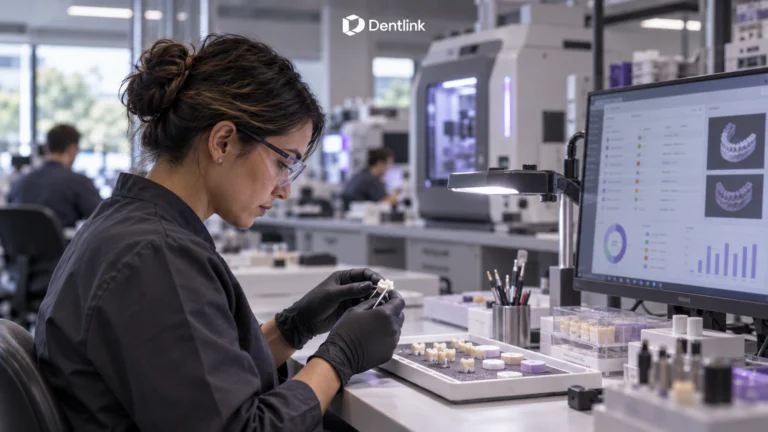
DSO Dental Lab Visit: What You Should Look for Behind the Cases
You see the restoration. But if you’re choosing a lab for multiple doctors or locations, the bigger question is what happens before it reaches the practice.
As your organization grows, you are not only relying on the final case. You are relying on the technology, technicians, workflow, communication, and infrastructure behind it.
That is why a DSO dental lab visit can tell you more than a fee schedule or sales presentation ever could.
Dr. Cedric Lewis, founder and CEO of four-location Kokua Smiles, recently visited Dentlink to see that process firsthand.
As a clinical leader working across multi-location dentistry, he understands what a lab relationship needs to look like beyond a single practice.
Before the visit, their experience with Dentlink was already clear:
“Dentlink has been a huge game changer for our practice. The interaction we have with our lab—it’s unparalleled.”
Then Dr. Cedric Lewis stepped inside the lab.
He saw the technology.
He watched a technician work on a real case.
And he got a closer look at the people and process behind the work his team already relied on.
His reaction after the visit?
“I have nothing but great things to say, and hopefully I can introduce more people to Dentlink because of what they’ve done for me.”
For a DSO decision-maker, that is the more useful question:
Does what happens behind the cases support the trust you are placing in the lab?
What Should You Look for During a DSO Dental Lab Visit?
A lab tour can easily become a walkthrough of equipment and workstations.
That is not enough.
A DSO dental lab visit should help you evaluate whether the lab’s technology, people, and workflow can actually support your organization at scale.
If you are evaluating a lab partner for multiple doctors or locations, use the visit to answer three practical questions:
- What technology supports your cases?
- Who is actually doing the work?
- Can the workflow support your organization as it grows?
Kokua Smiles had the opportunity to see all three firsthand.
1. What Technology Is Actually Supporting Your Cases?
The first question is not:
“Does this lab have new equipment?”
It is:
“What does this technology actually help the lab do better?”
During the Dentlink visit, Kokua Smiles saw the technology being used behind the cases.
“I was able to see the new technology they had.”
For a DSO, technology only matters if it helps reduce variation, improve visibility, and support more cases without adding more complexity.
- predictable production
- consistent case handling
- digital visibility
- communication across multiple clinicians
- capacity to support growing case volume
This is consistent with what DSO leaders should already be evaluating in a lab partnership: not simply whether technology exists, but whether the infrastructure behind it supports a scalable workflow. Dentlink’s DSO partner guide also identifies technology, visibility, and support as important areas to assess when evaluating a lab relationship.
What to ask during your visit
- What parts of the workflow are digital?
- How are cases tracked?
- What happens when case volume increases?
- Where does technology improve consistency?
- Where does technician judgment still matter?
That last question is especially important.
Because equipment is only one part of the case.
2. Who Is Actually Behind the Work?
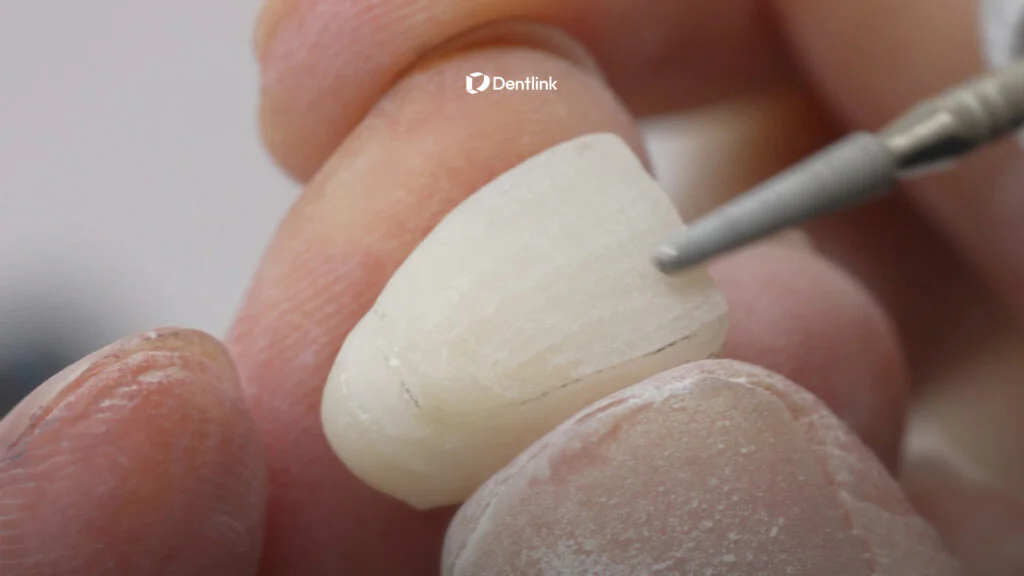
Dr. Lewis did not only see equipment.
He watched a Dentlink technician work on a case directly in front of them.
“I was able to watch their lab technician literally do a case in front of me.”
For a DSO, this is where the visit becomes more meaningful.
A lab can have strong infrastructure and still deliver an inconsistent experience if the technician relationship is unclear or fragmented.
You should know:
- Who owns the case?
- How experienced are the technicians?
- Can doctors communicate directly with them?
- How are clinical preferences carried from one case to the next?
- How is quality checked before the case ships?
Dentlink’s model is built around a designated technician relationship, with one master ceramist responsible for the case rather than the work moving anonymously through a queue.
That is also where Made by Masters becomes more than a slogan.
During a lab visit, you should be able to see the people behind the work—not just the machines behind the production.
3. Can the Workflow Support More Than One Doctor?
This is the question DSO leaders should pay the most attention to.
A workflow that works for one dentist does not automatically work for 20, 50, or 100 clinicians.
As your organization grows, every additional doctor and location adds another point where communication, preferences, or case details can break down.
More doctors → more cases → more communication → more opportunities for inconsistency
So when you visit a dental lab, look beyond the bench.
Look at how the system works.
A DSO dental lab visit is a chance to see whether that workflow can remain clear and consistent as more doctors and locations are added.
Ask:
- How do doctors communicate with technicians?
- What happens when a case needs clarification?
- Can multiple locations use the same workflow?
- How are delays or issues communicated?
- Can your organization standardize the relationship across locations?
- Is the lab infrastructure built to support additional volume?
This is also why lab evaluation cannot be separated from operational cost.
Managing multiple fee schedules, ordering systems, contacts, remake policies, and shipping workflows can create significant administrative complexity for a DSO. Standardizing lab relationships can reduce that burden and make performance easier to track across locations.
If you are comparing labs, this is worth reading alongside our guide to dental lab pricing for DSO organizations.
A Simple DSO Lab Visit Scorecard
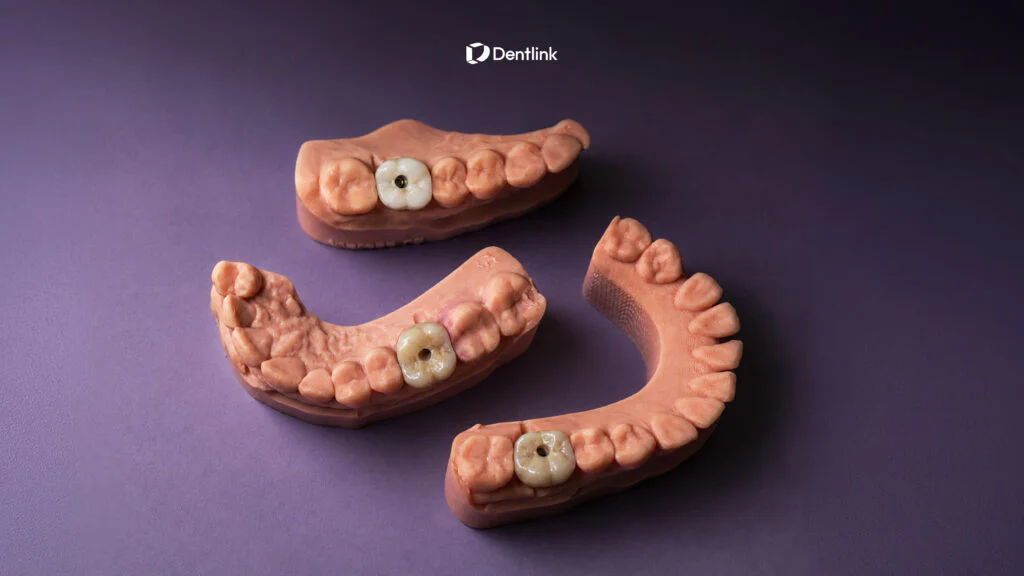
Don’t treat a lab visit like a facility tour. Treat it like vendor evaluation.
A DSO dental lab visit is more useful when your team knows exactly what it is trying to evaluate.
Use this quick checklist:
| Area | What to Look For |
|---|---|
| Technology | Does the equipment support consistency, visibility, and scale? |
| Technicians | Who owns the case, and how experienced are they? |
| Communication | Can doctors communicate directly with the right person? |
| Quality Control | How is the case checked before shipment? |
| Workflow | Can multiple clinicians and locations use the same process? |
| Capacity | Can the lab support meaningful volume growth? |
| Transparency | Can the lab show how the work actually gets done? |
| Support | Who helps when something goes wrong? |
This turns the visit from a facility tour into an actual evaluation.
And if your organization is still in the process of selecting a lab, our guide to 7 questions DSO leaders should ask when evaluating a dental lab partner gives you a broader framework.
The Strongest Proof Is What Holds Up When You See It
Every lab can say it has good technology.
Every lab can say it has experienced technicians.
Every lab can say it provides quality work.
A DSO dental lab visit gives you the chance to see whether those claims hold up.
That is what made the Kokua Smiles visit meaningful.
They were not walking into Dentlink as a prospect hearing the story for the first time.
They were already a customer.
They already knew what it was like to work with the lab.
The visit gave them the opportunity to see what was behind that experience.
And their response remained positive.
For a DSO evaluating a long-term lab relationship, that kind of alignment matters:
What you are told.
What your doctors experience.
What you see behind the cases.
Those three things should match.
What Should You Look for Before Choosing Your Next Lab Partner?
If your organization is considering a new dental lab, a DSO dental lab visit can help you evaluate more than the final restoration.
Look behind it.
Ask to understand:
- the technology supporting production
- the technicians responsible for your cases
- the communication model
- the quality-control process
- the infrastructure supporting scale
- the workflow your doctors will actually use
A strong lab partner should be able to show you how those pieces work together.
Evaluating a lab partner for your organization?
Don’t stop at the fee schedule or the finished restoration.
See the people, process, and workflow behind the cases.
Talk to Dentlink and see what working together could look like across your doctors and locations.
Dentlink. Made by Masters.
Your first crown is on us.
Free implant crown, free scanbody kit, and $200 off your next case. Just send your first scan.
Create your Dentlink account, register your clinic, add Dentlink as your lab in your scanner software, then send your case.